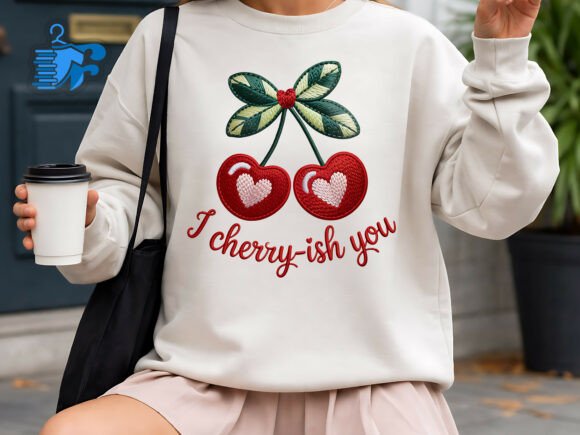
Cherry Love Embroidery Design
A Sweet, Simple Stitch That Wins on Wearability
As someone who’s stitched hundreds of designs across baby onesies, boutique aprons, and Etsy-ready tote bags, my first impression of Cherry Love Embroidery Design wasn’t about novelty—it was about fit. This isn’t a flashy, over-engineered motif. It’s clean, slightly retro, with soft curves and intentional negative space. The cherries sit gently within a heart outline—no heavy borders, no dense fill that screams “stitching nightmare.” It reads as friendly, warm, and quietly confident—not cutesy, not clinical. That balance is rare in T-Shirt Designs meant for real-world embroidery.
How It Landed on a Linen-Cotton Tea Towel (and Why That Matters)
Last week, I used Cherry Love Embroidery Design on a set of kitchen towels for a local café’s spring launch. Linen-cotton blend, medium weight, slightly textured. No fancy hoop tricks—just a standard 4x4 hoop and medium-weight tear-away stabilizer. What stood out immediately was how the satin stitch on the cherries held crispness without puckering, and how the heart’s open center kept the design breathable. Customers didn’t say “Oh, it’s embroidered”—they said, “I want one *now*.” That’s the sign of a design that supports the product, not competes with it. It works because it’s scaled thoughtfully: large enough to read at arm’s length, small enough to nestle neatly on a towel corner or pocket.
Where It Shines—and Where It Asks for Care
- Custom apparel: Looks especially fresh on lightweight sweatshirts and relaxed-fit tees—adds personality without overwhelming the garment’s drape.
- Baby embroidery: Soft lines and rounded forms make it ideal for onesies and burp cloths; avoids sharp angles or tiny details that snag or fray.
- Embroidered patch: Holds up beautifully when digitized for iron-on or sew-on patches—clean edges translate well to cut-and-sew workflows.
- Holiday embroidery & personalized gifts: Fits naturally into Valentine’s Day, bridal showers, or “just because” gift sets—its warmth reads emotionally, not seasonally locked.
- Craft business & Etsy seller use: Works reliably in printable mockups and digital previews—its clarity means customers instantly “get” the vibe, reducing back-and-forth on custom requests.
Fabric & Function: Know When to Pause
This design doesn’t demand special treatment—but it does reward attention. On stretchy knits like jersey tees? Use cut-away stabilizer and baste first. On dark fabric? Test thread contrast: light pink or cream cherry fills can disappear unless you choose a slightly brighter tone. On curved surfaces—like caps or tapered pillow covers—the heart’s gentle curve adapts well, but avoid placing it right over seams or high-stress folds where distortion could blur the shape. And while it’s not an applique design, don’t force it into ultra-tiny hoops (under 3x3”)—the stem detail and inner heart line need breathing room to resolve cleanly.
Stitch Density & Longevity: Quiet Confidence Over Flash
I checked the stitch density visually (no software count needed)—it’s moderate. No heavy fill stitches bogging down the cherries, no unnecessary underlay piling up beneath. That means less thread consumption, cleaner wash performance, and better drape on lightweight fabrics. For a handmade product meant to be used daily—like a tea towel, apron, or baby blanket—that’s not just practical, it’s part of the value proposition. Customers trust items that look and feel like they’ll last. Cherry Love Embroidery Design supports that trust by avoiding visual fatigue: it’s charming at first glance, still pleasing after six months of use.
Design Assets for Real Business Decisions
If you’re an embroidery designer or craft business owner evaluating this as a digital embroidery file, here’s what to verify before adding it to your workflow:
- Test it on scrap fabric matching your target product—especially if using textured or dark materials.
- Check thread color contrast in both black-and-white and full-color mockups—some reds mute on navy or charcoal.
- Review how the heart’s inner line and cherry stems render at actual size; zoom in on your embroidery software to confirm no stray nodes or thin vectors.
- Confirm hoop size compatibility—this design fits comfortably in 4x4, but double-check if your machine’s default settings require adjustment for consistent tension.
- Use proper stabilizer for your fabric type—medium tear-away for stable wovens, cut-away for knits, and lightweight fusible for delicate linens.
- Verify licensing: the description confirms commercial use is allowed across t-shirts, pillows, mugs, hoodies, canvas, greeting cards, and digital planners—so yes, you can sell finished products or bundle it into your own digital offerings.
Why It Feels Like a Keeper—Not Just a Trend
In a sea of over-digitized, overly saturated graphics, Cherry Love Embroidery Design stands out by doing less—thoughtfully. It doesn’t try to be everything. It’s not built for maximalist wall art or techwear branding. It’s built for the quiet confidence of a handmade product that says something personal without shouting. Whether it’s stitched on a nursery pillow, printed on a thank you card, or embroidered onto a small shop’s reusable tote, it carries warmth, clarity, and intention.
For Etsy sellers curating cohesive collections, it layers well with neutral palettes and natural fibers. For apparel decorators, it’s a reliable go-to when clients want “something sweet but not childish.” And for hobbyists building their first embroidery portfolio? It’s forgiving, teachable, and genuinely satisfying to watch come to life under the needle.
That’s the mark of a strong machine embroidery design—not how many bells it has, but how gracefully it serves the project, the person wearing or using it, and the maker bringing it to life.